How to Calculate Nutrition Facts for a Recipe (Step by Step)
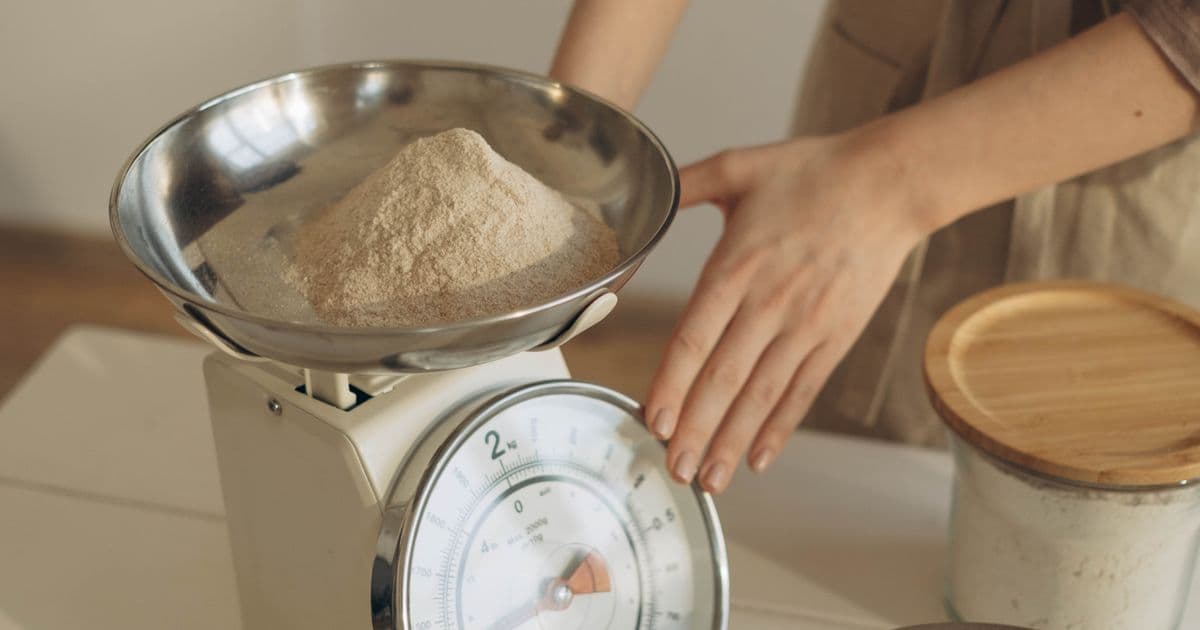
Calculating the nutrition facts for a recipe isn't guesswork, and it isn't a proprietary secret. It's a specific, repeatable arithmetic procedure. If you can add up a grocery receipt, you can compute a Nutrition Facts panel. The only genuinely hard parts are sourcing accurate per-ingredient data and getting unit conversions right. Here's the whole method, end to end.
- Convert every ingredient to a gram weight, then look up its nutrients per 100 g in USDA FoodData Central, the free, authoritative US source.
- Scale each ingredient's nutrients to its actual weight, sum across the whole batch, then divide by the number of servings.
- Apply the 21 CFR 101.9 rounding rules last: calories, fat and sodium each round differently, and %DV is always calculated from the unrounded amount.
- Cooking changes weight through moisture loss, which changes per-serving nutrient density. Weigh the finished product if your serving size is based on it.
- The whole procedure is mechanical, which is exactly why a small transposed number is the most common source of error in a hand calculation.
Step 1: Break the recipe into weighed ingredients
Start from the recipe as written, but restate every ingredient as a weight in grams. Volume measures like 'cups' and 'tablespoons' are ambiguous: a cup of flour and a cup of honey weigh very different amounts. The goal is to land on a gram weight for each line. If you already weigh ingredients in production, use those numbers directly; they're more accurate than any conversion.
- 2 cups all-purpose flour → ~240 g
- 1 cup granulated sugar → ~200 g
- 2 large eggs → ~100 g (about 50 g each, shelled)
- 1/2 cup unsalted butter → ~113 g
Step 2: Look up each ingredient in a food database
For each ingredient you need its nutrient profile per 100 g. The authoritative free source in the US is USDA FoodData Central, which publishes calories, fat, saturated fat, carbohydrate, sugars, protein, sodium, and dozens of micronutrients for thousands of foods. A USDA record gives you values normalized to 100 g, which is why converting everything to grams in Step 1 pays off now.
“Foundation Foods includes values for nutrients and other food components for a diverse range of basic foods... Foundation Foods will be a primary focus of efforts in coming years.”
That focus matters for anyone doing this calculation by hand: the database itself keeps getting more granular, which is good news for accuracy but means the 'right' record for a given ingredient can change as USDA updates it. Re-checking your source records periodically is worth doing before a print run, not just the first time you build a recipe (see what changed in the latest USDA FoodData Central release).
Step 3: Scale each ingredient to its actual weight
USDA gives nutrients per 100 g, so scale by the ingredient's real weight. For 240 g of flour where the record lists 364 calories per 100 g:
calories_from_flour = 364 * (240 / 100) = 873.6 kcalRepeat that same multiplication for every nutrient you care about (fat, saturated fat, carbohydrate, sugars, protein, sodium, and so on) for every ingredient. This is mechanical but unforgiving: one transposed number and the whole panel is off.
Step 4: Sum across all ingredients
Add up each nutrient across every ingredient to get the total nutrient content of the entire batch. If your four ingredients contribute 873.6, 774, 143, and 810 calories respectively, the whole recipe is 2,600.6 calories. Do the same summation column-by-column for fat, carbs, protein, sodium, and the rest.
| Ingredient | Weight used | kcal per 100 g (USDA) | Scaled kcal |
|---|---|---|---|
| All-purpose flour | 240 g | 364 | 873.6 |
| Granulated sugar | 200 g | 387 | 774.0 |
| Eggs (shelled) | 100 g | 143 | 143.0 |
| Unsalted butter | 113 g | 717 | 810.2 |
| Batch total | 653 g | — | 2,600.8 kcal |
Worked example: scaled calorie contribution per ingredient before rounding
Step 5: Divide by the number of servings
Nutrition Facts are always per serving, so divide every batch total by the number of servings. If the batch above yields 12 servings:
calories_per_serving = 2600.6 / 12 = 216.7 kcalOne important subtlety: the serving size on the label must be tied to the FDA Reference Amount Customarily Consumed (RACC) for the product's category, not simply 'the recipe divided by however many pieces came out'. If your pieces are much larger or smaller than the RACC, your servings-per-container has to reflect that.
Step 6: Apply the FDA rounding rules
The raw per-serving numbers are not what goes on the label. 21 CFR 101.9 dictates rounding increments that vary by nutrient. Calories round to the nearest 5 below 50 and nearest 10 above 50, so 216.7 becomes 220. Fats round to 0.5 g increments below 5 g and 1 g above. Sodium has its own 5 mg / 10 mg bands. Crucially, % Daily Values are computed from the unrounded amount and then rounded to a whole percent. They are not derived from the already-rounded gram figure.
Calories:  216.7  → 220
Total Fat:   9.4 g → 9 g
Sodium:    181 mg → 180 mg
Protein:     5.8 g → 6 g
Step 7: Account for what changes during cooking
For many recipes, calculating from raw ingredients is fine because nutrients are conserved. But water is not: a sauce that reduces by half concentrates everything per gram, and a dough that bakes off moisture weighs less finished than raw. If your serving size is defined by the finished weight, weigh the finished product and let the per-serving math reflect real yield, or use USDA 'cooked' records where they exist.
A small commercial bakery we've spoken with learned this the hard way with a banana bread recipe. They calculated nutrition from the raw batter weight divided by twelve slices, printed labels, and only later noticed the loaves consistently baked down by about 9% of their raw weight through moisture loss. Their real per-slice calorie count was quietly higher than the label claimed, because the same total nutrients were now packed into less mass per slice. Re-weighing the finished loaf and recalculating from the actual baked weight, not the batter weight, fixed it before it became a labeling problem rather than after.
Doing it without the spreadsheet
Every step above is exactly what Mealary automates. You paste the recipe as written; it parses each line, matches it to a USDA FoodData Central record, converts household units to grams using food-specific densities, sums the nutrients, divides by your servings, and applies the 21 CFR 101.9 rounding, then shows you the cited USDA source behind every number so you can verify it. The manual method is worth understanding precisely so you can sanity-check the automated one.
- Convert every ingredient to grams.
- Pull per-100 g nutrients from USDA FoodData Central.
- Scale, sum, divide by servings.
- Apply 21 CFR 101.9 rounding; compute %DV from unrounded values.
- Verify against finished yield before printing.
Once the numbers are right, formatting them into a compliant panel is a separate skill: see our full Nutrition Facts label guide for every mandatory line, or our FDA rounding and Daily Value guide if you want the increment-by-increment rules in one place. If your recipe is really about hitting a protein or macro target rather than a full label, our recipe macro calculator guide covers that angle specifically.
You can estimate with volume-to-gram conversions, but accuracy suffers: a cup of packed brown sugar and a cup of sifted flour convert very differently. A scale accurate to 1 g removes the biggest source of manual error.
As accurate as your ingredient matching and unit conversions. Picking the wrong USDA record (salted vs. unsalted butter, raw vs. cooked) is the single biggest error source. The arithmetic itself is simple addition and division.
Calories and most macronutrients are conserved during cooking, but weight often isn't: moisture loss concentrates nutrients per gram in the finished product. Weigh the cooked result if your serving size is based on the finished item.
USDA FoodData Central lists many ingredients in both raw and cooked forms with different per-100g nutrient values, because moisture and fat content change during cooking. Match the record's state to how you're actually measuring the ingredient.
The underlying arithmetic is the same, but supplements use a different mandatory format and reference values under 21 CFR 101.36. See our supplement facts label guide for what changes.
Stop calculating nutrition by hand
Mealary turns any recipe into per-serving nutrition and a print-ready FDA Nutrition Facts label. It's computed from USDA FoodData Central, with the rounding and %DV done for you and every value cited to its source.